AI Model Validation vs. CSV Validation: Clarifying the Differences and Connections

In the world of GxP-regulated environments, a significant misconception is present among many professionals who sometimes confuse AI model validation with Computer System Validation (CSV). While these validation approaches share certain foundational principles and objectives, they represent entirely independent activities with completely different methodologies and evidence requirements. This can lead to unclear or inadequate validation strategies, regulatory compliance gaps, and faulty deployments of AI systems in GxP-regulated organizations. This is why understanding these differences is crucial for efficient and compliant implementations of artificial intelligence solutions in life sciences.
What is CSV Validation?
If you are reading this article at gxpblackbox.com, chances are I do not need to explain this, but for the sake of clarity, let’s sum up the essentials.
Computer System Validation (CSV) is a documented process of establishing evidence that a computerized system will consistently perform according to predetermined specifications and quality attributes throughout its lifecycle. CSV is not a technical exercise but a regulatory requirement designed to ensure that computerized systems are fit for their intended use.
So, what is AI Model Validation?
AI model validation includes a comprehensive set of processes and activities designed to ensure that AI and ML models perform accurately, reliably, and ethically according to their intended specifications. This systematic evaluation goes beyond traditional software validation by addressing the unique challenges of probabilistic systems that learn from data and may exhibit unpredictable behaviors.
AI model validation focuses on statistical performance, generalization capabilities, and continuous monitoring to ensure sustained reliability in production environments.
Within the Software Development Lifecycle (as defined by GAMP5), AI model validation predominantly sits in the Configuration & Coding and Verification & Testing phases. Just as “traditional” computerized system validation, AI model validation extends beyond initial implementation. It requires continuous oversight after deployment, ensuring the AI model meets predefined performance criteria, maintains robustness, and reliably delivers accurate predictions throughout its operational life.
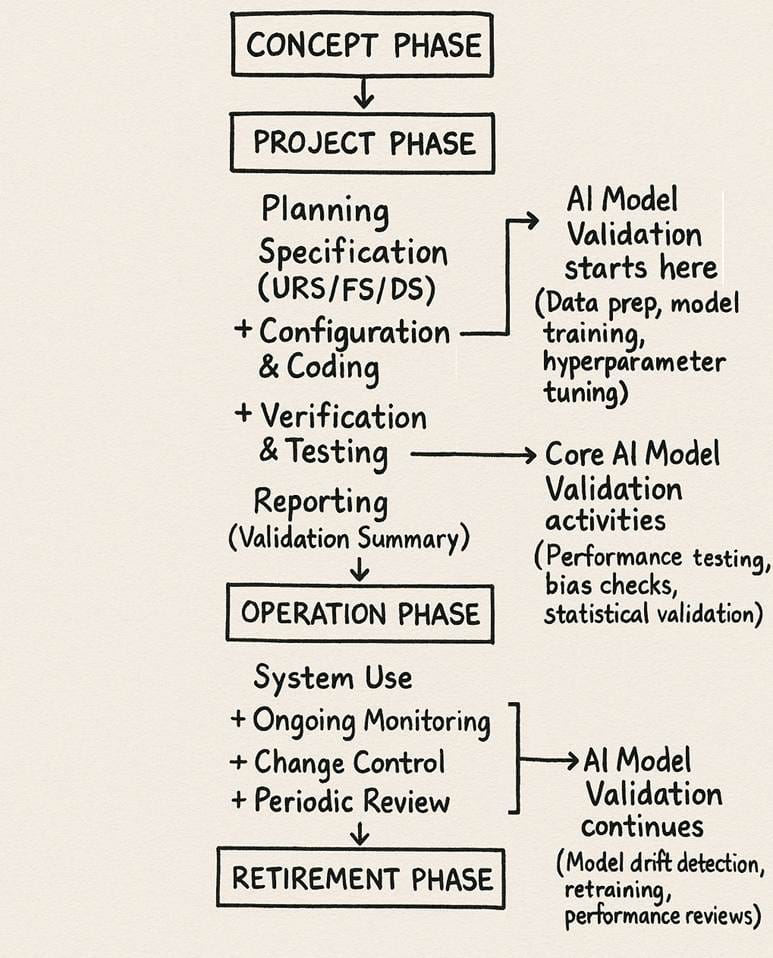
Key Goals of AI Model Validation
Ø MODEL GENERALIZATION
The primary objectives of AI model validation address the fundamental challenges inherent in machine learning systems. Ensuring model generalization represents the core validation goal, confirming that models perform reliably on new, unseen data beyond their training datasets. This involves rigorous testing across diverse data scenarios to verify that learned patterns translate effectively to real-world applications.
Ø BIAS MITIGATION
Validation must identify and address potential biases in model predictions that could lead to unfair or discriminatory outcomes. This includes examining performance across different demographic groups or data segments.
Ø DRIFT DETECTION AND MANAGEMENT
Models must be validated for their ability to maintain performance over time as data distributions change. This includes establishing baselines and monitoring mechanisms for detecting performance degradation.
Ø TECHNICAL ROBUSTNESS
Validation ensures the model handles edge cases, missing data, and unexpected inputs gracefully without failing or producing erroneous results.
Ø RELIABILITY AND REPRODUCIBILITY
The model should produce consistent results given the same inputs and maintain stable performance across different deployment environments.
Steps of AI Model Validation
Ø AI model validation follows a systematic step sequence that begins with comprehensive data collection and verification of its quality metrics. The goal is to ensure that the data used for model validation is representative, unbiased, and suitable for the intended use case while maintaining data integrity according to GxP standards (it’s not a guaranteed outcome though, but rather the intent).
Ø Data splitting creates distinct training, validation, and testing datasets that enable unbiased model evaluation. The typical split allocates 70-80% of data for training, with the residual data being divided between validation (hyperparameter tuning) and testing (final evaluation). This separation prevents data leakage and ensures honest assessment of model performance.
|
Data leakage is when information that should be restricted to the validation or test phases “leaks” into the training process, leading to overly optimistic performance metrics and a model that will likely fail in real-world deployment. |
Ø Hyperparameter tuning optimizes model configuration parameters that control the learning process. Hyperparameters are predefined settings that influence how a model learns and how its architecture behaves. Unlike model parameters (weights) that are learned from data, hyperparameters must be set before training begins. Key hyperparameters include
· Learning Rate: Controls how quickly the model adjusts its parameters during training. Too high can cause instability, too low results in slow convergence.
· Batch Size: Determines how many training examples are processed before updating model parameters. Affects training speed and model stability.
· Number of Epochs: Specifies how many times the entire training dataset is processed. Must balance between underfitting and overfitting (you can find explanations of these terms later in this article).
· Regularization Parameters: Control the complexity of the model to prevent overfitting. Examples include L1/L2 penalties and dropout rates.
· Architecture-Specific Parameters: For neural networks, this includes the number of layers, neurons per layer, and activation functions. For tree-based models, it includes tree depth and minimum samples per leaf.
Ø Performance evaluation employs multiple statistical metrics to assess model effectiveness. The following quantitative measures can be used to evaluate model performance:
· Accuracy: Proportion of correct predictions across all classes
· Precision: Proportion of positive predictions that are actually correct
· Recall: Proportion of actual positives correctly identified
· F1-Score: Harmonic mean of precision and recall
· ROC-AUC: Area under the Receiver Operating Characteristic curve, measuring classification performance across various decision thresholds
· RMSE: Root Mean Square Error (for regression tasks)
· Log Loss: Measures the performance of classification models

Ø Error analysis identifies overfitting and underfitting issues that compromise model performance.
|
Overfitting occurs when models memorize training data details rather than learning generalizable patterns, resulting in poor performance on new data. In overfitting, training accuracy is high while validation accuracy remains significantly lower. This accuracy gap indicates that the model performs well on known data but fails to generalize to new inputs, meaning it has learned the dataset too well—including noise or irrelevant patterns. Underfitting happens when models are too simple to capture underlying data patterns, leading to poor performance on both training and test data. In underfitting, both training and validation accuracy stay low, suggesting the model lacks the capacity to learn the underlying structure of the data. |
Ø Final evaluation on a dedicated dataset provides unbiased assessment of model performance using data completely separate from training and validation sets.

Ø Ongoing monitoring implements continuous evaluation of model performance in production environments, tracking metrics like prediction accuracy, data drift, and model degradation over time.
Nature of Evidence
AI model validation relies heavily on statistical methods, mathematical proofs, and quantitative performance metrics. Evidence includes e.g. cross-validation results, confusion matrices, statistical significance tests, and algorithmic performance benchmarks. This evidence is probabilistic in nature and often requires interpretation within confidence intervals.
CSV validation emphasizes comprehensive documentation, procedural repeatability, and rigorous testing protocols. Evidence consists of detailed test scripts, execution records, deviation reports, and formal approval documentation. The CSV standard requires objective, reproducible results that can be independently verified and audited.
Risk Management
Both validation approaches implement comprehensive risk management frameworks that identify, assess, and mitigate potential hazards to product quality and patient safety. CSV validation employs risk-based approaches, focusing on failure modes related to functional, compliance or business process-related risks. AI model validation incorporates similar risk assessment methodologies while addressing unique AI-specific risks such as algorithmic bias, model drift, and prediction errors.
Risk assessment documentation in both domains requires systematic identification of potential failure modes, probability assessments, impact analysis, and mitigation strategies. The integration of these risk management approaches enables comprehensive coverage of both traditional system risks and AI-specific algorithmic risks.
Conclusion
The distinction between AI model validation and CSV validation represents a critical understanding gap that organizations must address to successfully deploy artificial intelligence in GxP-regulated environments. While these validation approaches share common regulatory objectives and quality principles, they operate through fundamentally different methodologies, evidence standards and operational frameworks. CSV validation emphasizes system functionality, documentation rigor, and static validation cycles, while AI model validation focuses on statistical performance, continuous monitoring, and algorithmic reliability.
Organizations must extend traditional CSV frameworks to accommodate AI-specific validation needs. This integration demands comprehensive training, clear communication protocols, and adaptive documentation practices that bridge traditional validation expertise with emerging AI validation competencies.
As artificial intelligence continues to transform pharmaceutical and life sciences operations, the evolution of validation practices must balance innovation with the fundamental regulatory principles that protect patient safety and product quality. This requires sustained commitment to validation excellence, continuous learning, and adaptive regulatory strategies that enable organizations to harness AI's transformative potential while maintaining the highest standards of compliance and quality assurance.