Context matters

What is context management?
Artificial intelligence, including large language models, is already being used to review documents, support validation, summarise deviations, or assist in laboratory and quality processes. In these systems, the model does not work in isolation. It works on what we give it.
That input is usually a mix of documents, data extracts, instructions, prompts, system rules, and defaults built into the system. It defines what the model sees, what it ignores, and how it responds. Yet this material is often assembled quickly, modified frequently, and rarely reviewed with the same care as the system’s output. This imbalance creates risk. If the context is incomplete, outdated, or inconsistent, the result may still look plausible... but it will not be reliable. Managing context is therefore not a technical detail but a core control mechanism.
In practical terms, context in an AI system is built from several parts that work together. These include the instructions given to the model, the current user request, earlier exchanges in the same session, information pulled from documents or databases, outputs from connected tools, and the format the response is expected to follow.
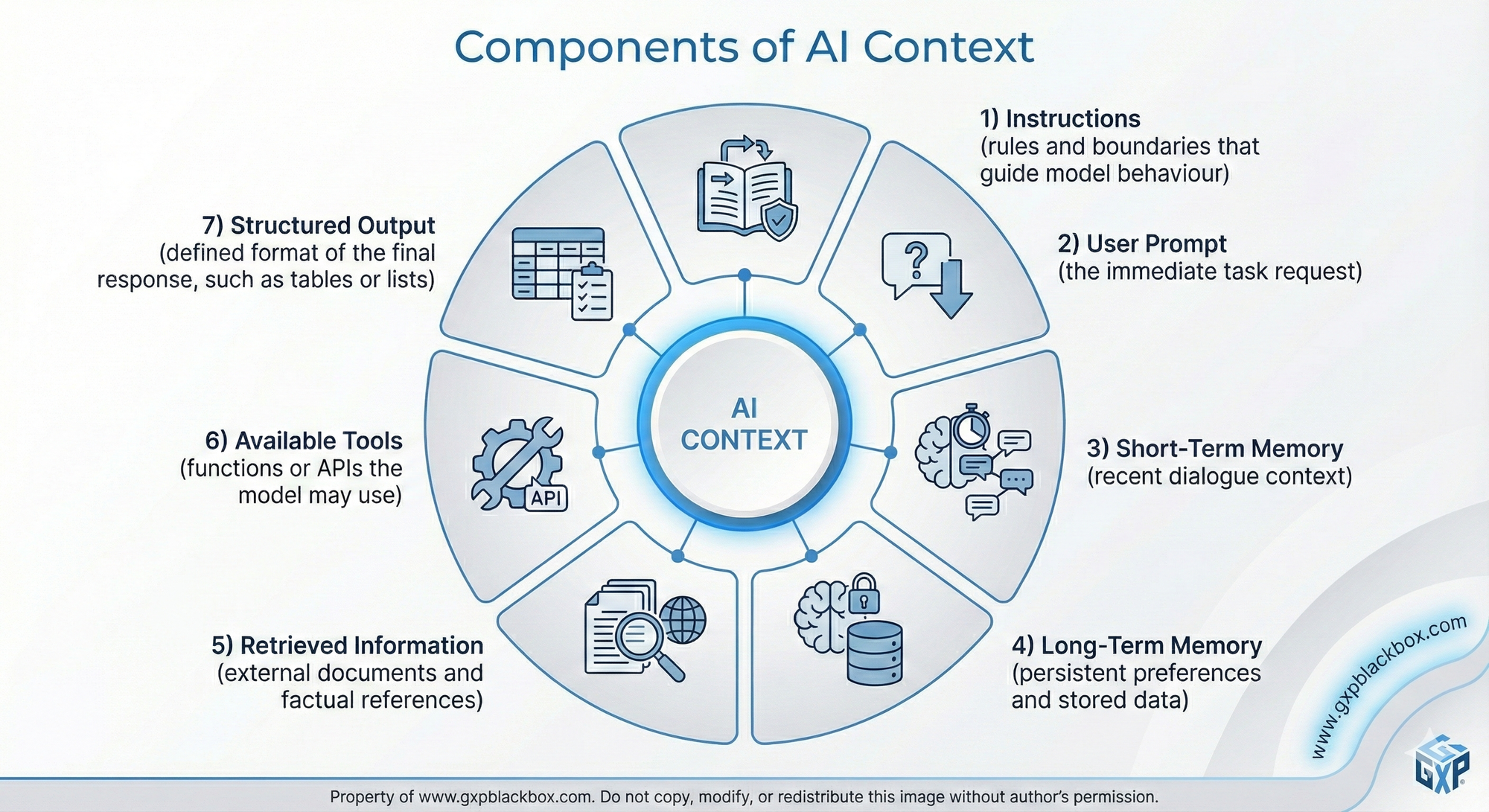
Together, these elements decide how the model understands the task and what it treats as relevant. When they are aligned, the system behaves in a stable and predictable way. When they are mixed, outdated, or overloaded, the results become harder to explain and sometimes impossible to reproduce.
These building blocks are already well described in the research literature and can be grouped as shown below.
Table 1. Core Components That Shape an AI System’s Context
| Component | Description |
|---|---|
| Instructions | Define rules, boundaries, and general behaviour expected from the system. |
| User Prompt | Represents the immediate task or question that activates the model. |
| Short-Term Memory | Maintains recent dialogue, ensuring continuity and reducing repetition. |
| Long-Term Memory | Stores persistent information across sessions and preferences. |
| Retrieved Information | Adds external, verified knowledge from approved sources. |
| Available Tools | Enables calculations, data processing, or integrations with other systems. |
| Structured Output | Ensures responses follow a defined format (tables, lists, JSON, etc.). |
When these elements are not thought out and blended without structure, the model can easily drift away from what is needed. Larger context windows make this more likely, because the model must "review" all available input and decide itself on what deserves attention. This introduces several well-documented failure patterns. These issues appear frequently during early AI adoption, including GxP settings:
Table 2. Failure Modes Related to Poor Context Organisation
| Failure Mode | What Happens | Why It Matters in GxP |
|---|---|---|
| Context Poisoning | Incorrect or misleading inputs distort downstream reasoning. | May lead to inaccurate decisions, invalid statements, or flawed calculations. |
| Context Distraction | The model overfocuses on the context, ignoring foundational knowledge. | Produces looping, repetitive, or incomplete answers, slowing processes. |
| Context Confusion | Semantically similar but irrelevant documents are used. | Risk of referencing the wrong SOP, outdated requirement, or incorrect standard. |
| Context Clash | Conflicting instructions or documents appear simultaneously. | Leads to inconsistent outputs, creating challenges for auditability and trust. |
| Additional Risks | Omission, positional bias, random access limitations. | Important details may be overlooked, especially in long inputs. |
These patterns resemble known challenges in data integrity and document control. They are not new risks, they are new expressions of long-standing principles. This is why GxP, CSV, and quality specialists often recognise the importance of context management immediately: they already work within environments where the correctness, completeness, and consistency of information determine whether a process stands up to inspection.
To support reliable performance, several structured practices have emerged. The following summary groups common practices into a form familiar to lifecycle-driven environments:
Table 3. Practices That Improve Context Reliability
| Practice | Purpose | Benefit for Regulated Use |
|---|---|---|
| Retrieval-Augmented Generation | Selects only relevant information for each task. | Reduces noise and supports traceability of sources. |
| Tool Loadout Management | Limits available tools to those needed for the task. | Minimises accidental use of unintended functions. |
| Context Quarantine | Separates unrelated topics or knowledge areas. | Prevents cross-contamination of information streams. |
| Context Pruning | Removes outdated or unnecessary history. | Keeps prompts concise and auditable. |
| Context Summarisation | Replaces long text with structured summaries. | Retains meaning while reducing volume. |
| Context Offloading | Stores background knowledge outside the prompt. | Ensures clarity and consistency across sessions. |
Each of these practices outlines how context can be treated as a managed artifact rather than an informal conversation. The parallels with established quality systems are clear. Retrieval boundaries resemble controlled document repositories. Tool restrictions mirror access controls. Summaries and pruning reflect lifecycle management of data. Quarantine resembles segregation of environments. These concepts make it easier to connect AI oversight with practices familiar to those who manage system qualification, data governance, or procedural compliance.
Structured context management also clarifies responsibilities. Technical teams gain predictable patterns for retrieval and tool integration. Quality and validation specialists gain checkpoints for assessing whether AI-supported steps remain within approved boundaries. Operational teams gain confidence that decisions produced by AI are grounded in accurate, relevant, and current information. Context governance formalises the information pathways already needed for reliable operation.
Clearer context also has a practical impact. Systems that consistently receive well-organised inputs require fewer corrections, generate fewer rework cycles, and produce outputs that align better with documented expectations. Over time, this improves efficiency and reduces the likelihood of deviations triggered by unclear or inconsistent system behaviour.
The direction of progress is fairly straightforward. As AI systems become an integral part of regulated processes, the structure surrounding context will become as important as the model itself. Organisations that treat context as a controlled input will find it easier to maintain reliability, demonstrate compliance and integrate AI into broader digital transformation programs. Those principles have guided regulated environments for decades, and they continue to hold value as AI becomes another component in the life sciences technology ecosystem.
You can check my LinkedIn posts about context management if you are interested in knowing a bit more: