When Search Starts Interpreting: Rethinking AI Search in Regulated Systems

“Search” has long existed as a technical function - a way to locate information by matching words or identifiers. In regulated environments, this understanding is closely connected to expectations around reproducibility and traceability. When the same query is executed repeatedly, the expectation is that the result remains consistent and attributable to clearly defined sources. This principle is familiar from GxP and CSV contexts, where repeating the same test scenario is expected to produce the same outcome.
Consider a simple situation: an ALM or EDMS user searches for a specific procedure, deviation, or requirement and repeats the same query several times. In a traditional system, the result set remains stable. The same documents appear in the same order, allowing the user to rely on the search function as a consistent entry point to controlled information. This stability is not merely convenient - it underpins how users navigate documented processes and confirm what information is available.
AI-powered search tools change this behavior in ways that are not always visible to users. Although the interface may resemble traditional search, the underlying mechanisms rely on probabilistic interpretation rather than deterministic matching. As a result, identical queries can produce different outputs depending on context, ranking logic, or internal processing. This variability is not always obvious at the interface level, yet it shapes how information is retrieved and presented.
This article describes these differences at a conceptual level, explaining how AI search operates, how it differs from traditional keyword-based approaches, and why these differences become more visible in GxP contexts.
Keyword search and semantic search as different logics
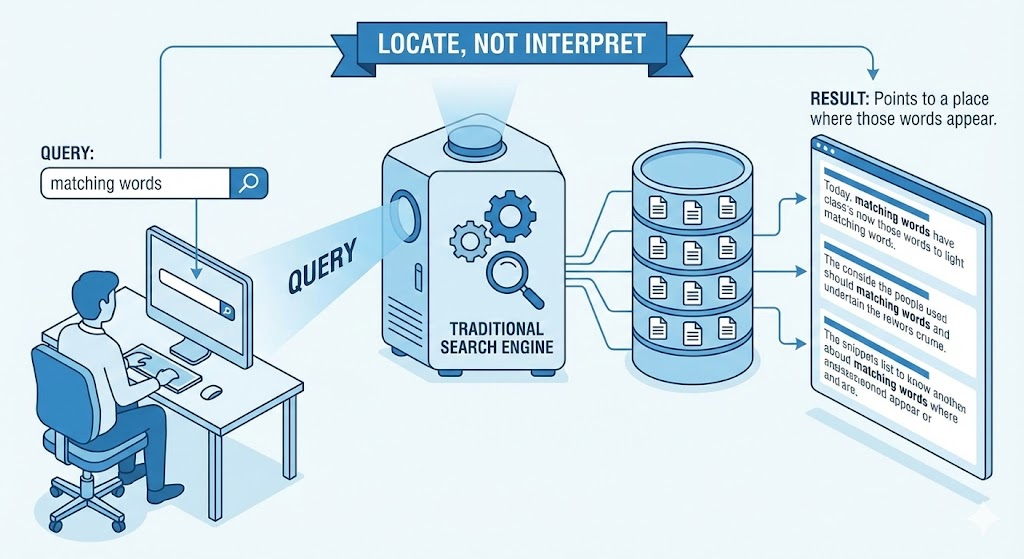
Keyword search is based on lexical matching. It identifies documents or records that contain the same words or predefined patterns as the query. The logic is direct: if the term is present, the document qualifies. Variations in wording are handled through predefined rules such as synonyms, indexing strategies, or filters, and the same query typically produces the same result set.
Most users approach search with this intuitive understanding. A query is entered, the system looks for matching terms, and the result points to places where those terms appear. The role of the system is to locate information, not to interpret it. Because the mechanism is explicit and rule-based, the relationship between query and result remains relatively transparent.
AI search systems operate differently. They are designed to process natural language queries and return information that is statistically related in meaning, not only in wording. Instead of matching exact terms, the system evaluates similarity across language representations derived from training data and indexed content. The output may still appear as a list of documents or a concise response, but the process that produced it involves interpretation at multiple stages, including ranking, contextual weighting, and sometimes synthesis.
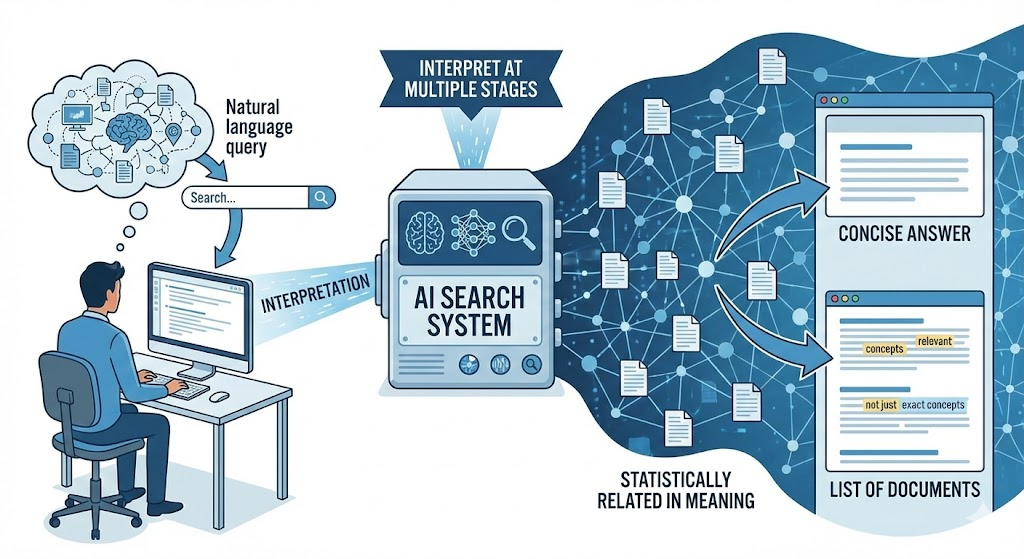
From a structural perspective, traditional keyword search answers the question “where does this term appear?” while semantic search answers “what content is most similar in meaning?”. This shift from lexical matching to similarity-based retrieval explains why AI search often feels more flexible, but also less predictable, even when it is applied to the same underlying intended use.
Typical failure patterns in regulated contexts
When semantic retrieval and language generation are introduced into search functions, the behavior of the system changes in subtle but important ways. These changes are not unique to regulated environments, but they become more visible there because expectations around completeness, specificity, and traceability are higher.
One common pattern is omission. AI search systems prioritize information based on estimated relevance to the query, rather than on predefined rules that determine exactly what must be included in the results. As a result, documents or records that are present in the underlying repository may not appear in the result set if the system evaluates them as less semantically similar to the query. From the user’s perspective, this omission is not visible at all. The output remains coherent and complete in tone, even when alternative sources were available but not surfaced.
Another pattern is over-generalization. When multiple sources address related topics, semantic retrieval and summarization can blur the differences between them. Distinctions in scope, conditions, or context may be reduced as the system produces a concise response. The result can appear internally consistent while masking variability present in the original material.
A related effect is the loss of local nuance. Specific phrasing, exceptions, or boundary conditions that exist in source documents may be deprioritized during ranking or condensed during synthesis. This does not occur because the information is absent, but because the system optimizes for semantic coherence and readability when constructing an answer.
Variability across repeated queries can also occur. Because semantic search relies on probabilistic ranking and contextual interpretation, identical queries may not always produce identical outputs. Changes in surrounding context, indexing updates, or internal weighting can influence which documents are prioritized or how responses are assembled. This variability is often subtle and may only become noticeable when the same query is repeated or examined closely.
These patterns are difficult to detect in everyday use because AI-generated outputs tend to be fluent and confident. The system does not typically signal which sources were excluded, which interpretations were deprioritized, or how alternative formulations might have produced different results. What appears as a single, stable answer is often the result of multiple internal selection and interpretation steps that remain largely invisible to the user.
Closing reflection
When LLM-based search is introduced into systems traditionally considered low risk - such as document repositories or knowledge bases - the interaction with those systems can change. If search begins to return synthesized answers or contextual summaries instead of simple document locations, the output may directly influence how users interpret requirements, procedures, or past events. In this way, AI-mediated search can reshape the practical risk profile of otherwise low-risk systems, because the meaning it constructs may affect human decisions in ways that traditional search never did.